
Searching San Saba County Criminal Dockets
No county-hosted criminal case index was found during the official-source review. Start with the issuing court. Felonies normally belong to the District Clerk, county-level misdemeanors to the County Clerk, and fine-only matters to the Justice Court or the municipal court that issued the citation. The Texas Judicial Branch court-record FAQ confirms that trial-court records remain with the clerk of the court where the case was filed.
Use the exact cause number when possible. Keep punctuation and leading zeros. A name can help a clerk narrow the search, but it can also match more than one file. Include the court, filing year, and a date range. State whether inspection, an ordinary copy, or a certified copy is needed.
- Identify whether the matter is district, county, justice, or municipal.
- Gather the cause number, filing year, and only the party details needed to distinguish the file.
- Call or visit the correct clerk, or mail a focused request to that office.
- Ask to inspect the public docket before paying for copies.
- Confirm the current fee and request certification only when an authenticated copy is required.
San Saba Felony Court Routing
San Saba County felony dockets are associated with the multicounty 33rd and 424th Judicial District Courts. The District Clerk is the record keeper for filings made in San Saba County. A judge may work across several counties, so the judge's base or another county's hearing room does not change the filing clerk. The cause number and filing county are better routing keys.
The official county pages list the 33rd District Court and the 424th District Court separately. The published phone numbers are 512-756-5436 and 512-756-5438. Those court contacts can clarify assignments, while the District Clerk handles the filed record.
The county's 424th District Court page provides a useful view of the local court contact block.
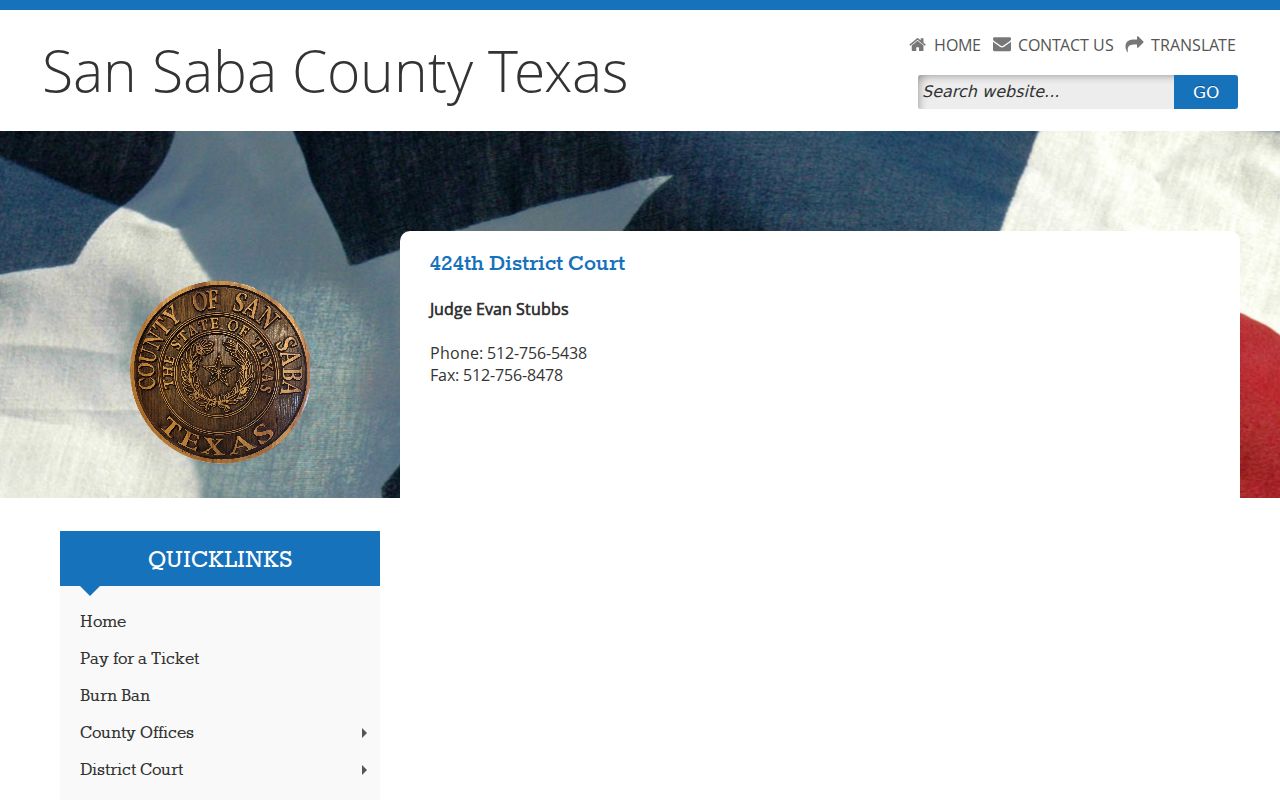
That contact page identifies the court, but it is not a searchable criminal docket.
Inside a San Saba County Criminal Docket
A criminal docket is a chronological case record, not every document in the file. Entries may identify a charge, filing, setting, plea, order, disposition, or sentence. A filing means a document reached the clerk; it does not mean the judge granted it. A setting is a scheduled event and may later move. Read the signed judgment or order before treating a short docket label as the final outcome.
| Cause number | The court-assigned identifier; preserve its exact punctuation and leading zeros. |
|---|---|
| Charge | The alleged offense, statute, and level when shown publicly. |
| Settings | Arraignment, pretrial, plea, trial, or sentencing dates, subject to change. |
| Filings and orders | Motions, notices, and rulings entered in date order. |
| Disposition | Dismissal, plea, conviction, acquittal, or another resolution, best verified in the actual order. |
re:SearchTX Criminal Search Limits
re:SearchTX provides a state framework for cases, filings, documents, and hearings after registration. It is still not a one-stop San Saba County criminal docket. The official Texas Judicial Council data report says criminal case records are excluded from the system. A blank result therefore does not prove that no criminal case exists.
The portal's sign-in screen makes that boundary visible.
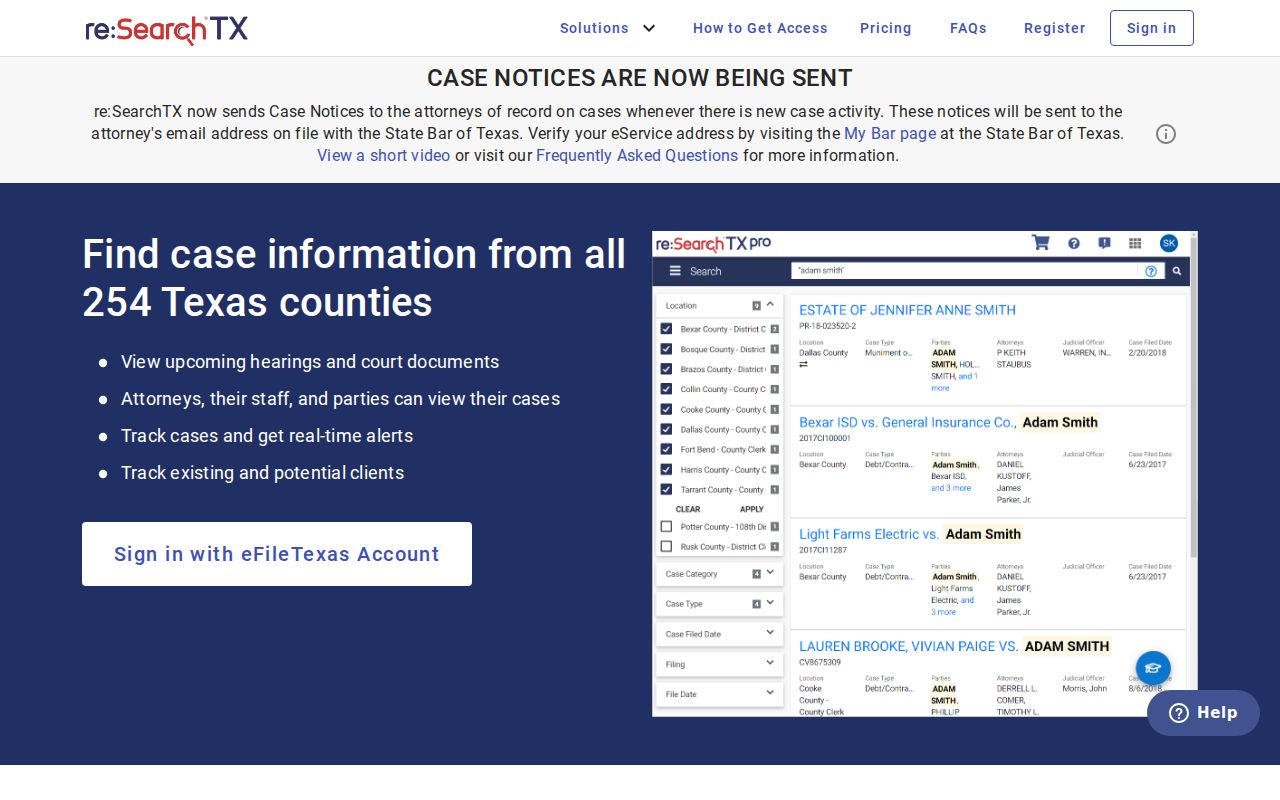
Use the portal only as a supplemental check. For criminal material, the direct clerk route remains essential. The separate San Saba County case lookup explains name and number searches across available systems.
Note: A no-result screen can reflect coverage limits, spelling, access controls, or the wrong court rather than the absence of a case.
How a Criminal Case Moves
The sequence depends on the charge and court. A district felony may begin with charging and grand-jury activity, then move through arraignment and pretrial settings. A county misdemeanor follows the county court's process. Fine-only cases use justice or municipal procedures. Not every stage appears in every case, and multiple resets may sit between them.
San Saba criminal docket flow: Filing › Arraignment › Pretrial › Plea or Trial › Disposition › Sentencing
A plea entry is not always the final judgment. Likewise, a dismissal label should be checked against the filed order. When an entry is unclear, request the public document tied to that event date.
San Saba Criminal Activity Context
Official activity reports give context but cannot identify a person or hearing. For September 1, 2023 through August 31, 2024, the San Saba district criminal row showed 87 active pending cases at the start, 69 added, 84 disposed, and 72 active pending at the end. The constitutional county court criminal row showed 116 at the start, 40 added, 41 disposed, one inactive, and 114 at the end.
The OCA FY2024 reports count activity categories, not unique people and not today's open cases. Never use those figures as a live docket.
Courts That Hold Criminal Dockets
San Saba County criminal records follow the court level. The District Clerk keeps felony and related district files. The County Clerk keeps constitutional county-court misdemeanor records. The countywide Justice Court and the two municipal courts hold their own fine-only and local citation dockets. Federal crimes are separate again, in the Western District of Texas Austin Division.
| Matter | Record holder | Starting point |
|---|---|---|
| Felony | District Clerk | 33rd or 424th District Court |
| County misdemeanor | County Clerk | Constitutional County Court |
| Fine-only or traffic | JP or municipal clerk | Issuing authority |
| Federal offense | Federal clerk | PACER, Austin Division |
Do not send a city citation to the countywide JP solely because both offices appear at the courthouse. Match the citation's issuing court first.
San Saba Clerk Request Options
The County/District Clerk is at 500 E. Wallace, Suite 202, San Saba, TX 76877, and publishes 325-372-3614. The office can be contacted by phone, visited at the counter, or addressed by mail to the correct function. The county directory also lists fax 325-372-6484, but no current page confirms that court-copy requests are accepted by fax. No clerk record-request email or drop box was located.
Published office hours are Monday through Thursday, 8:00 a.m. to noon and 1:00 to 5:00 p.m., and Friday, 8:00 a.m. to noon and 1:00 to 4:00 p.m. Ask whether a file is paper, scanned, sealed, archived, or held off site. Also ask about present copy fees and payment methods. The county's property-record fees are not criminal court-copy fees.
County/District Clerk
Christi Whitley
500 E. Wallace, Suite 202
San Saba, TX 76877
325-372-3614
Sealed Dockets and Public Access
Public access does not expose every criminal detail. Sealed matters, grand-jury material, juvenile records, and sensitive identifiers can be withheld or redacted. Redaction removes protected data from a public copy; it does not erase the docket. Expunction and nondisclosure are distinct legal remedies, so a missing portal result should never be labeled as either one.
Key Rules:
Texas Rule of Judicial Administration 12 generally permits inspection and copying of judicial records, subject to exceptions.
Texas Family Code Chapter 58 restricts juvenile records and identifying information.
Texas Rule 21c redaction requirements protect specified personal and financial identifiers in court filings.
Ask for the public, non-sealed part of the record. If access is denied, request the rule or order supporting the decision and ask whether a redacted portion can be released.
San Saba Grand-Jury Notice Limits
The District Clerk page displayed an upcoming grand-jury summons for August 5, 2026 at 8:30 a.m. during the research snapshot. That is one public notice. It is not a complete grand-jury docket, a list of investigations, or proof of an indictment.
Grand-jury material can have strong confidentiality limits. Use the notice only to confirm what it says. For a public criminal case that later appears in district court, ask the District Clerk for the filed docket and public documents by cause number. Do not infer a person's status from the summons notice.
Note: Always recheck a published date with the clerk because a notice may change after it is captured or indexed.